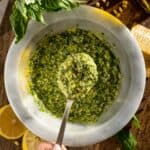
Mortar and Pestle Pesto Recipe (with food processor directions!)
The best pesto recipe! This pesto is bright, herbaceous, savory, and garlicky. It’s a great sauce for pasta, proteins, vegetables, pizzas, sandwiches, and spreads.
Servings 6 servings
Calories 225kcal
Equipment
- Microplane
- Knife
- cutting board
- Spider strainer, optional
- Mortar and pestle, food processor, or knife/mezzaluna
Ingredients
- 4 cloves garlic smashed and peeled
- ¼ cup toasted pine nuts
- 4 cups fresh basil leaves lightly/loosely packed, about 3 ounces
- 1 ounce freshly grated parmigiano reggiano cheese
- ½ cup extra virgin olive oil
- 1-2 tablespoons fresh lemon juice
- 1-2 tablespoon white balsamic vinegar
- salt to taste
Instructions
- BLANCH. Optional, see note. Add the basil leaves to a pot of boiling water and submerge for about 10 seconds. Transfer the basil to a bath of ice water with a spider strainer. Drain basil and squeeze out excess water. Rough chop blanched basil to make it easier to blend.
MORTAR AND PESTLE
- MASH GARLIC. In the mortar, mash the garlic cloves into a paste with a pinch of coarse salt. Rock the pestle in a circular motion around the mortar.4 cloves garlic
- MASH PINE NUTS. Next, add pine nuts and mash together with garlic forming a thick mash.¼ cup toasted pine nuts
- MASH BASIL. Add in basil (one handful at a time if not blanched). Continue to grind the ingredients until you achieve the desired consistency.4 cups fresh basil leaves
- STIR. Stir in parmesan, olive oil, lemon juice, and white balsamic vinegar with a spoon and mix to combine.1 ounce freshly grated parmigiano reggiano cheese, ½ cup extra virgin olive oil, 1-2 tablespoons fresh lemon juice, 1-2 tablespoon white balsamic vinegar
- FINISH. Add salt to taste.
FOOD PROCESSOR
- PULSE GARLIC. Add garlic to the food processor and pulse a few times until garlic is finely chopped.4 cloves garlic
- PULSE PINE NUTS. Next add pine nuts. Pulse until desired consistency.¼ cup toasted pine nuts
- PULSE BASIL. Add in basil leaves, lemon juice, and white balsamic vinegar. Continue to pulse until basil is chopped to desired consistency.4 cups fresh basil leaves, 1-2 tablespoons fresh lemon juice, 1-2 tablespoon white balsamic vinegar
- STIR. Remove the blade and stir in olive oil and parmesan with a spoon.½ cup extra virgin olive oil, 1 ounce freshly grated parmigiano reggiano cheese
- FINISH. Add salt to taste.
Notes
- Makes about 1 1/4 cup
- Store fresh basil is in a jar of water at room temperature.
- White balsamic vinegar is optional but adds a touch of sweetness and acidity. Do not substitute for regular/dark balsamic vinegar.
- Blanching. If you are storing or freezing this pesto for later, it’s a good idea to blanch the basil leaves to keep their bright color. If you are eating it right away, you can skip it.
- Use a microplane to grate the parmesan cheese. Texture should be like fluffy snow.
- Don’t pour olive oil into the food processor. If you add olive oil while running the food processor, it will emulsify and become thick and creamy, changing the texture of the pesto. It is better to stir it in after.
- The order you add ingredients matters! The order you add and mash/pulse the ingredients will have an effect on the final texture.
- Texture. You can make the pesto as smooth or chunky as you like by grinding or pulsing more or less. If you want a thinner consistency pesto, stir in more olive oil.
- Don’t heat it! When using pesto for pasta, boil pasta and reserve some pasta water. Add cooked al dente pasta to a pan with a splash of pasta water off of heat, and stir in pesto. Toss together until combined and serve immediately.
- Other ways to make pesto. You can also make this pesto with an immersion blender (follow the same steps as food processor directions), or with a knife. To make pesto with a knife (or mezzaluna), finely chop all ingredients, then stir in parmesan and liquids.
- How to store leftovers: Store leftover pesto in an airtight container in the refrigerator for 2-3 days. If basil was not blanched, the color will turn dark green.
- How to freeze: Add pesto to ice cube trays with a thin layer of olive oil on top and freeze until solid, then transfer to a freezer bag. Defrost in the refrigerator overnight.
Nutrition
Calories: 225kcal | Carbohydrates: 3g | Protein: 3g | Fat: 23g | Saturated Fat: 4g | Polyunsaturated Fat: 4g | Monounsaturated Fat: 15g | Cholesterol: 3mg | Sodium: 78mg | Potassium: 99mg | Fiber: 1g | Sugar: 1g | Vitamin A: 883IU | Vitamin C: 5mg | Calcium: 90mg | Iron: 1mg